Renovation of pitched Roofs from the outside

Is your roof in need of renovation, but you'd like to preserve the interior finish? Or perhaps you want to keep the interior beams visible?
Do you want to reduce your heating costs and value acoustic comfort and minimizing summer heat? Do you also prefer working with sustainable materials?
Then our system solution "renovation of pitched roofs from the outside" is the right choice for you.
This page was automatically translated. Minor translation errors may occur. In case of doubt, the original Dutch and French versions are correct.
Download (Dutch version)
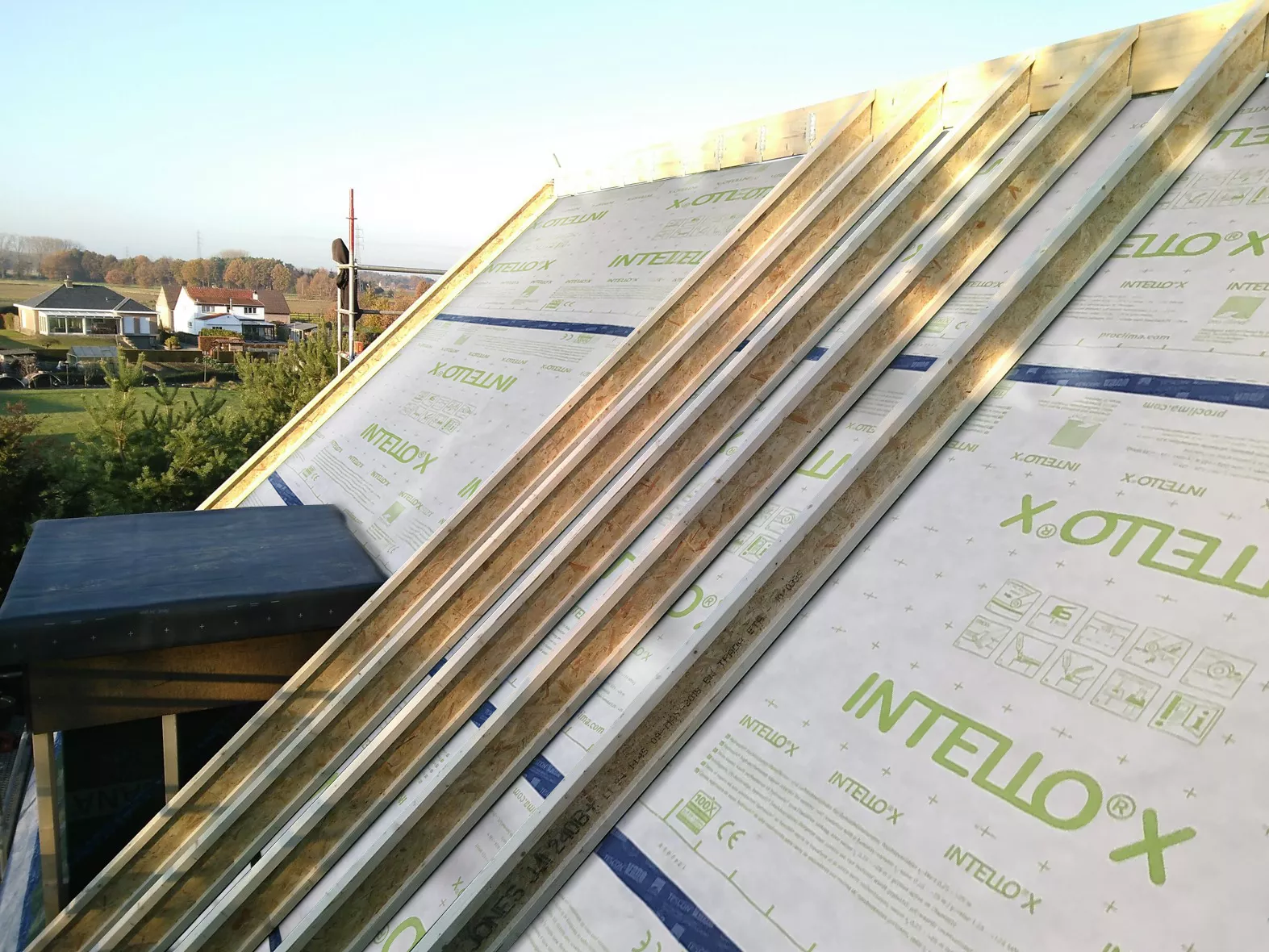
What does our insulation system "Renovation of pitched roofs from the outside" consist of?
Thanks to the renovation solution for a pitched roof from the outside (also known as a “sarking roof”), it's possible to install insulation on top of the existing roof structure without negatively affecting the space beneath the roof.
There are several variants depending on:
- The method used to build the thickened roof structure:
- Installing new self-supporting rafters (solid wood or I-beams) and possibly a new ridge beam;
- Installing a transverse board to support the new rafters, at least at each overlap of the pro clima INTELLO X membrane;
- Installing rafters using spacer screws;
- Installing a new double row of rafters;
- How the vapour barrier is supported:
- With wire mesh (“chicken wire”);
- Using semi-rigid insulation between existing roof rafters;
- On the existing battens if they are in good condition;
- Using the battens that support the interior finish;
- With thin rafters placed between existing rafters;
- The type of underlay:
- Thin rigid fibre cement board;
- Insulating wood fibre board;
- Underlay membrane suitable for blown-in insulation.
It is impossible to describe all possible combinations. However, within our "renovation of pitched roofs from the outside" solution, the following variants are discussed:


Of course, other possibilities and assemblies using our products also exist. If they are not mentioned in the brochure, please contact our helpdesk. Our specialists are always ready to assist.
Also, don’t forget to consult with a certified iQ3 cellulose installer before starting roofing and airtightness work so they can pre-approve the structure to be insulated.
Note: What are the characteristics of a good renovation?
At ISOPROC, we advocate one essential principle across all our solutions: good insulation is more than just a thick layer of material!
Wind, temperature differences, and mechanical ventilation create pressure differences between the inside and outside of a building. Even the smallest cracks or holes in the building envelope can lead to uncontrolled air exchange, effectively bypassing the insulation. In winter, this can cause energy loss, discomfort, condensation issues, and reduced efficiency of the ventilation system. In summer, uncontrolled airflow increases the risk of overheating.
To insulate effectively, airtight and windproof construction is just as important. This principle is central to all our solutions.
Gebruikte producten
Afhankelijk van de gekozen variant, werken we met volgende producten:
- Celit 4D onderdak
Premium onderdak vervaardigd uit duurzame PEFC houtvezel
of pro clima SOLITEX MENTO PLUS gewapende onderdakfolie. - iQ3-celulose isolatie
- pro clima INTELLO X PLUS
Sterke, vochtvariabele, weer- en UV bestendige, luchtdichte damprem voor alle vezelvormige isolatiematerialen. - pro clima AEROSANA VISCONN (FIBRE)
Coating voor luchtdichting (met vezels versterkt) - pro clima TESCON VANA
Allround tape met vliesdrager, voor binnen en buiten - pro clima ORCON F
Allround-aansluitlijm voor binnen en buiten - pro clima lijm, tapes en toebehoren
Voor het dichten van overlappingen, aansluitingen, doorboringen, ...
Products used
Depending on the chosen variant, we use the following products:
- Celit 4D underlay
Premium underlay made from sustainable PEFC-certified wood fibre
or pro clima SOLITEX MENTO PLUS reinforced underlay membrane. - iQ3-celulose insulation
- pro clima INTELLO X PLUS
Strong, hydrosafe, weather- and UV-resistant vapor barrier for all fibrous insulation materials - pro clima AEROSANA VISCONN (FIBRE)
Airtight coating (fibre-reinforced) - pro clima TESCON VANA
All-round tape with fleece carrier tape for interior and exterior use - pro clima ORCON F
Universal adhesive for interior and exterior sealing - pro clima glue, tapes and accessories
For sealing overlaps, joints, penetrations, etc.
Example of a pitched roof renovation from the outside
What are the advantages of our insulation system “Renovation of pitched roofs from the outside”?
- No need to temporarily vacate the upper floor.
- Interior finishes remain intact.
- Even large insulation thicknesses do not reduce available interior space.
- Enjoy a renewed roof that’s ready for decades of service.
- This roof assembly allows for very efficient insulation with ease. Using 225 mm-high rafters in our solution achieves an R-value of approximately 5.9 (m²·K)/W.
- Insulation can extend beyond the outer wall, ensuring continuity with current or future wall insulation and airtightness.
- Unlike many other roof assemblies (e.g., sandwich panels), our solution allows for excellent acoustic insulation. In research on insulating roofs near airports, the 7 tested assemblies with cellulose insulation performed 5 to 11 dB better than the strict requirement of 40 dB noise reduction at low frequencies.
- The combination of Celit 4D underlay with iQ3 cellulose insulation, together with measures such as external sun shading and appropriate ventilation, provides protection against both winter cold and summer heat.
The Celit 4D underlay not only provides an additional insulation layer but is also much more robust than underlay membranes.
The combination of Celit 4D, iQ3 cellulose insulation, and pro clima INTELLO PLUS moisture-variable vapour retarder minimizes the risk of building damage (e.g., wood rot) and unhealthy mold due to moisture. This is achieved by integrating three core strategies for moisture management:
- Prevent moisture ingress from the interior via airtightness and the INTELLO vapour barrier.
- Maximize drying potential, allowing trapped moisture to dry outward through Celit 4D or inward through the variable barrier retarder when conditions permit.
- Moisture buffering, allowing temporary absorption in Celit underlay and iQ3 insulation, with later evaporation.
Insects don't stand a chance: Celit 4D on the exterior and INTELLO on the interior block access to wood. If any insects are present in the wood at the outset, they cannot escape due to the dense iQ3 filling, preventing reproduction.
Option 1: Self-supporting rafters
- The simplest sarking renovation solution using iQ3 cellulose insulation.
- Existing fibrous insulation between rafters can remain.
Option 2: Rafters on transverse board
Existing battens (and possibly underlay and insulation) remain, offering benefits:
- Existing battens (and possibly underlay and insulation) remain, offering benefits:
- Saves time by avoiding removal of battens and nails.
- Prevents damage to interior finishes that can occur when battens are forcefully removed.
- Reduces waste.
- Roof acts as a working platform (“ladder”), easing installation and protecting finishes.
Option 3: Rafters with spacer screws
- Also insulates the space between existing rafters.
To assess environmental impact, use the TOTEM tool. TOTEM is jointly developed by the three Belgian regions and allows for objective comparison of the total environmental impact of different construction assemblies.
For example, the total environmental impact of a pitched roof (with tiles, battens, Celit 4D underlay, 175 mm rafters insulated with mineral wool, vapour barrier, cross battens, and gypsum fibreboard finish) with a U-value of 0.22 W/(m²·K) can be improved:
- By 7%, simply replacing standard mineral wool with the same thickness of iQ3 cellulose.
- By 31%, increasing the rafter and iQ3 cellulose thickness to 300 mm.
*In addition to energy consumption over 60 years, TOTEM accounts for global impact (CO2 and nitrogen emissions, water and raw material usage, ozone impact, and many other factors) from raw material extraction to demolition of the building.
We documented this beneficial solution “Renovation of pitched roofs from the inside” in a detailed brochure. It contains essential information, 2D drawings, installation instructions, and practical tips. It also includes the external renovation method. Download the system solution (in Dutch) below.
Still have questions? Don’t hesitate to contact our free technical helpdesk. We’re happy to share our expertise.
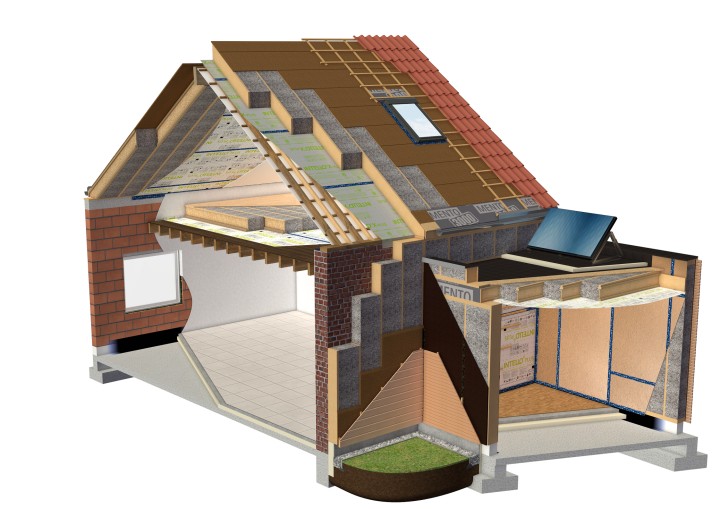
All system solutions
Our system solutions combine all of ISOPROC's expertise. They include guidelines, detailed drawings, and coordinated products for an optimal approach to pitched roofs, flat roofs, walls, joinery, etc.
